Understanding the 20 Minute Neighbourhood

Download the report      Low Resolution - 13MB       High Resolution -100MB

Neighbourhoods where people can pop out to a shop, cycle to their doctor or walk children to school are places that many people have enjoyed in the past. But, given planning and urban design practices since the proliferation of the car, being able to do this cannot be taken for granted today. As local authorities look to tackle climate change, air pollution and promote healthier lifestyles, they are also looking to develop places where people can live well locally. 

Some towns and cities already offer their citizens this style of living. For others, there is a widespread ambition to see 20-minute neighbourhoods widely woven into existing urban, suburban and rural life, so that people there can ‘live well locally’. In Scotland, for example, the government has committed itself to implementing 20-minute neighbourhoods nation-wide alongside its actions and ambitions for net-zero greenhouse gas emissions by 2045.

A major attraction of the 20-minute neighbourhood is that it appears straightforward and easy to grasp. But this is an illusion. Behind this seemingly simply idea lies a great deal of complexity, making it difficult to achieve in practice. Many post-war neighbourhoods have been designed around the car. Creating a 20-minute neighbourhood requires bringing together many strands, not all of them in the gift of the local authority, and many beyond the control of planners and urban designers. Implementing them may require overcoming a degree of fear and scepticism from local stakeholders. 

So what are the necessary ingredients to create a 20-minute neighbourhood? How do you bring them together? And how do you get the necessary buy-in from stakeholders? 

This is what the guide seeks to explain. It is intended for anyone who wants to improve their understanding of the meaning and implications of 20-minute neighbourhoods. This includes politicians, policymakers, local council officers and councillors, developers, planners, designers, NGOs, local businesses, community groups and residents’ associations. And urban designers and planners will find it useful too. 

The guide takes readers through key considerations for a 20-minute neighbourhood strategy. This includes the following ideas.
• Understanding and articulating the desired outcomes that politicians, planners, architects, urban designers and other decision makers want to achieve.
• Correctly assembling the means - mechanisms, levers, triggers and causal factors – necessary to produce a 20-minute neighbourhood.
• Setting out the changes and behaviour required to support the successful operation of a20-minute neighbourhood (essential even where the ends and means can be achieved).

A ‘20-minute neighbourhood’ defies clear definition. There is no single paradigm around which to organise thought and action. Instead, there are competing viewpoints about how best to deliver 20-minute neighbourhoods, and how much priority should be given to each of their component parts. Each case or project has its own specific context and circumstances. What may work in designing a new urban neighbourhood may not apply when retrofitting an existing one. 

We hope that armed with the knowledge and advice in this guide, both professionals and lay people seeking to develop 20-minute neighbourhoods will feel better informed and more confident about if and how to rollout the concept to suit their local circumstances. 

Special thanks are given to sponsors and contributors Urban Design Group, Sustrans, ADAM Architecture,  Corstorphine & Wright Architects, Hilson Moran, and Proctor & Matthews Architects


• Understanding and articulating the desired outcomes that politicians, planners, architects, urban designers and other decision makers want to achieve.
• Correctly assembling the means - mechanisms, levers, triggers and causal factors – necessary to produce a 20-minute neighbourhood.
• Setting out the changes and behaviour required to support the successful operation of a20-minute neighbourhood (essential even where the ends and means can be achieved).


Sub-heading: 
Making opportunities for people to live well locally
Publication Type: 
Other Manuals and Briefings
Publication Date: 
Friday 19 April 2024
Image: 
Understanding the 20 Minute Neighbourhood Publication Urban Design Group

National Urban Design Conference 2023

Rethinking Place

This two day not-for-profit event is the first National Urban Design Conference for four years.  We will be reflecting on the dramatic changes that have occurred over that period and how towns and cities need to be rethought and reimagined to meet the challenges. 

Featuring 

       Tom Hunt, Leader, Sheffield City Council

       Sarah Allan, Head of Architecture at Department for Levelling Up, Housing and Communities 

        and over thirty other leading speakers

Download the Full Programme


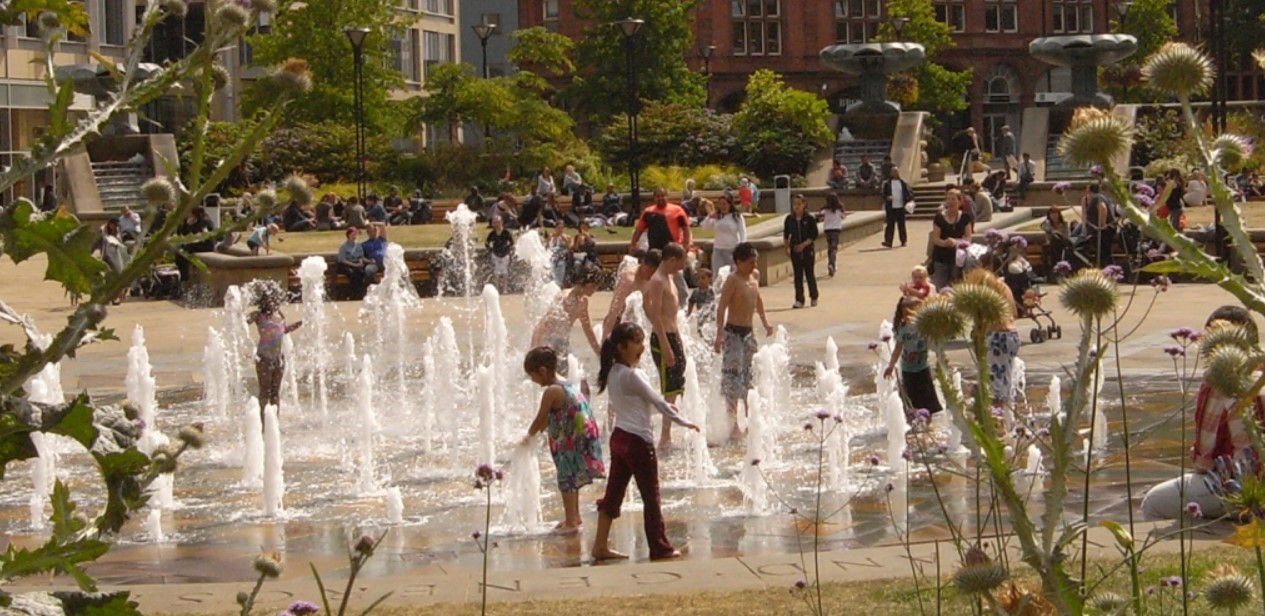
Sheffield Peace Gardens : The conference takes place in Sheffield, which has many examples of sustained multi-decade regeneration and reinvention.  


Sponsors

Sponsored tickets for local authorities - see below


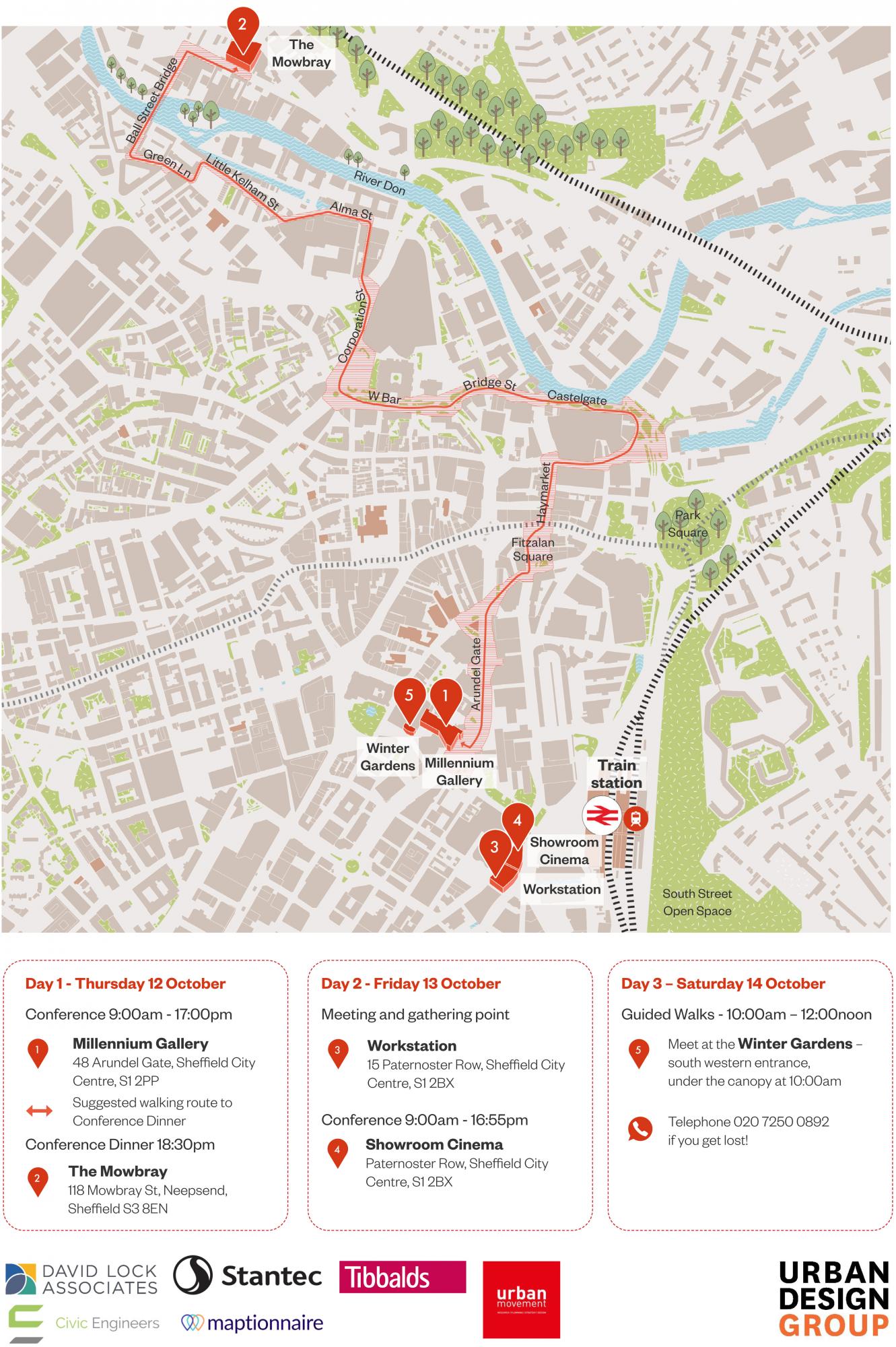
Day 1 Thursday 12 October

Millennium Galleries, Arundel Gate Sheffield S1 2PP - 6 minutes' walk from the railway station

  • Regeneration

  • Streets
  • Neighbourhoods
  • Urban Design Awards Category Finalists - Masterplans - Design Codes - Guidance - Completed Schemes

The Sheffield Story – Mark Mobbs, Marketing Sheffield
Sheffield approach – Tammy Whitaker, Sheffield City Council
New Neighbourhoods  – Joanne Cave, David Lock Associates
Low Traffic Neighbourhoods – Chris Martin – Urban Movement
Net Zero Neighbourhoods – Chris Thompson, CITU
Sustainable Neighbourhoods – Caleb Jones – Planet IE
Rethinking Streets and Movement  – Ana McMillin, Broadway Malyan
Green Blue Urban  – Speaker to be confirmed
Resilient Streets – Zac Tudor, Arup
Reimagining the In Between – Phillippa Banister, StreetSpace
Streets for a Healthy Life  – Katie Parry, Homes England
Streets: State of the Art Review  – Leah Stuart, Civic Engineers
Rethinking Practice – Simone Gobber Stantec
Rethinking Neighbourhoods  – Husam Al Waer – University of Dundee

More speakers to be announced 


Day 1 : Conference Dinner: Urban Design Feast

Taking place at "The Mowbray" one of Sheffield's most interesting regeneration venues, 118 Mowbray St, Neepsend, Sheffield S3 8EN


Day 2 Friday 13 October 2023

Showroom Workstation – Sheffield’s independent Cinema - Paternoster Row, Sheffield City Centre, Sheffield S1 2BX – 2 minutes’ walk from the railway station.

  • Strategic Planning and Growth
  • Reuse vs demolition and rebuild
  • Health and well-being
  • The role of local authorities
  • Centres: town centres, high streets, neighbourhood centres, and centres in new development

Speakers Include:

Rethinking the way we shape towns and cities  – Roger Evans
Rethinking High Streets – Toby Hyam
Repurposing at the neighbourhood scale – Jane Manning, Allies and Morrison
Zero carbon housing  – Michael Jones, City of York Council
Council housing – A long-term perspective – Leo Hammond, Haringey Council
Championing Design and Placemaking in Local Authorities – Chris King East Suffolk Council
Creating Well-designed places in Scotland – What does it take – Robert Richardson, University of Glasgow
Improving Design Quality through the Planning System – Doncaster Case Study – Jordan Butler, Doncaster Council
Producing design codes in the public sector – Greeshma Girish Broxbourne Borough Council
Design Coding – John Stiles, Brent Council
Citizen engagement – Maptionnaire
21st century urban design for well-being and resilience | Let’s code for it! Together – Angela Koch, Imagine Places
Pandemic Play Spaces: Rethinking Places in Times of Crisis through Play – Michael Martin University of Sheffield
A rating tool evaluating urban design features for active healthy living  – Eleni Tracada, University of Derby
Active Travel  – Dan Crane – Active Travel England
Placemaking 101 – the fundamentals of placemaking based on environmental psychology – Jonathan Tarbatt, Corstorphine & Wright Architects
What to do with department stores  – Mark Latham, Urban Splash
Creating Centres in New Development – Julia Wallace, Otterpool Park LLP


Day 3 Saturday Morning Guided Walks

Including the Grey to Green project, and Sheffield's main city centre and public realm programmes, including Castlegate and the "Heart of the City".


Tickets 

We warmly welcome everyone and anyone, from any background, with an interest in the design and improvement of towns and cities, streets and spaces. 

Non-members – If you are not yet a member, do check whether it would save you money to join the Urban Design Group.  (Membership takes immediate effect on receipt of payment.) 

UDG Members – save 35 % on the standard ticket prices*  UDG Member

UDG Registered Practices - bring half or more of the professional staff in the office and save 38 % on the standard ticket prices* - you can bring any member of staff, and guests at these rates.   UDG Registered Practice - Bring the Office

*excludes the conference dinner – which is offered at cost.

Local Authorities - sponsored tickets Further details and booking 


Standard rate

UDG Members

UDG Registered Practice - Bring the Office

Package 1 Full Conference

380.00

247.00

235.60

Package 2 Day 1+Dinner

240.00


148.80

Package 3 Dinner+ Day 2

240.00


148.80

Day 1 Conference

150.00

97.50

93.00

Day 2 Conference

150.00

97.50

93.00

Dinner only

95.00

95.00

95.00


A people friendly event....  run to make a difference.... not a profit. 


Book your hotel accommodation for the event

Sheffield City Council has very kindly made a hotel booking facility available to help delegates attending the conference.

Reservations can be made using the web address below until 28 days prior to the event start date. On this date some hotels will choose to leave unsold rooms on the system, or they may remove them. The site will close fully 14 days prior to the event start date.

The special link for accommodation is here


There have been huge changes since the last conference in 2019 that call into question our understanding of how towns and cities work and should be designed, including:

  • the shift towards home-working
  • the rapid acceleration during lockdown of internet retail, the hollowing out of local shops and high streets, and the near extinction of department stores
  • the loss of consumer spending from central business districts, in favour of suburbs and smaller towns.
  • controversy over low traffic neighbourhoods, a “war on motorists”, and ultra-low emission zones, versus the health, safety and wellbeing of children and communities at large.
  • conspiracy theorists attacking 15 minute cities and 20 minute neighbourhoods as means to remove freedom and control lives.

and this is on top of all the existing challenges such as

  • climate change
  • the 2050 net zero 2050 target
  • the shortfall in house-building
  • the continued focus on low-density car-dependent housing built away from shops, jobs and facilities
  • the need for balanced economic growth – including production as well as consumption.

So its an opportunity for Rethinking, and to renew our resolve to make progress.


UDG Event: 
UDG Event
Images: 
National Urban Design Conference 2023 Urban Design Event
Date and Time: 
Thursday 12 October 2023 (All day) to Friday 13 October 2023 (All day)
Image: 
Urban Design Group Events National Urban Design Conference 2023
STREET Event: 
Non-STREET Event
Venue: 

Sheffield

Conference: 
National Urban Design Conference

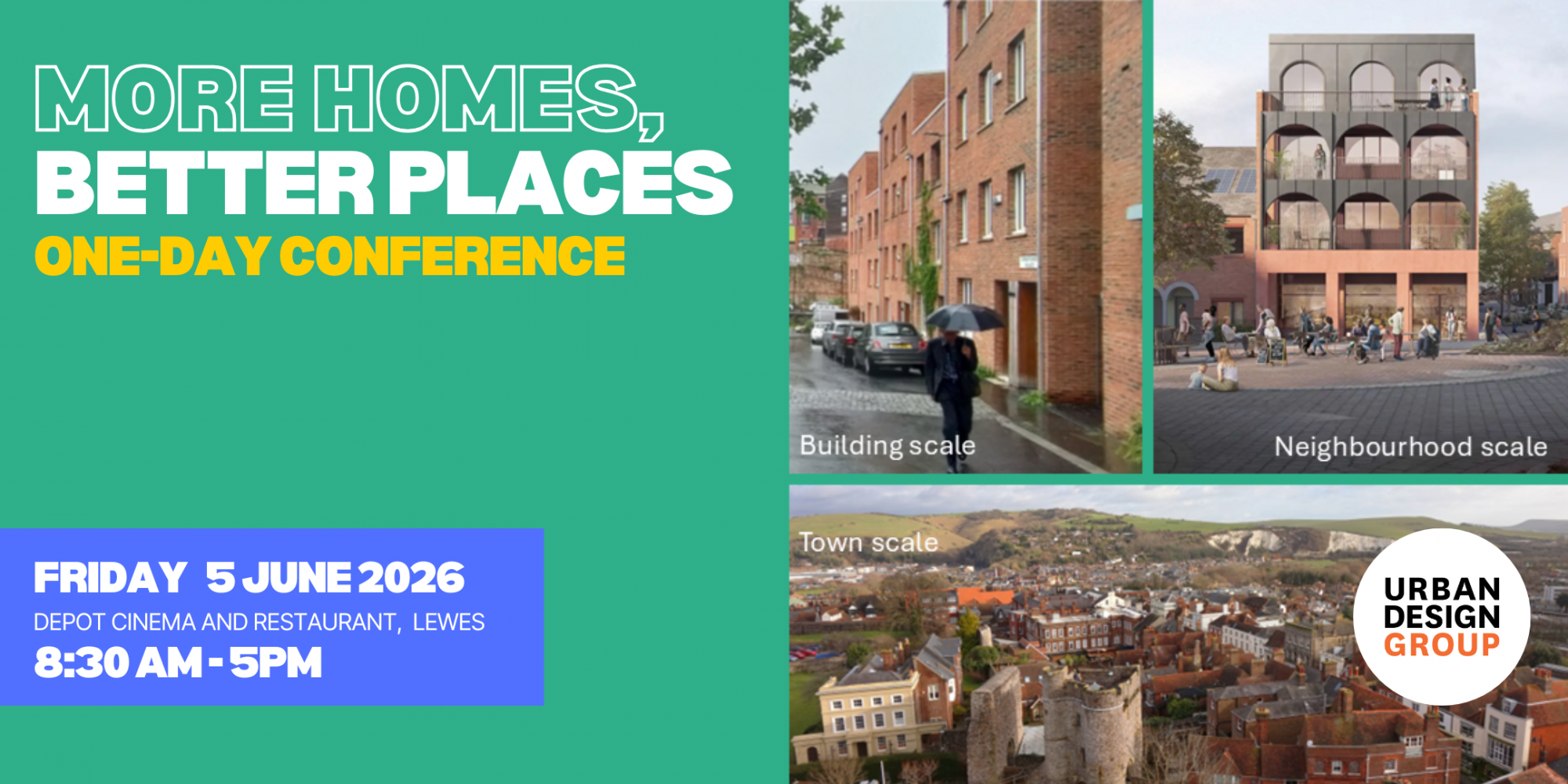
More homes, better places


How to address the housing and placemaking crisis
across building, neighbourhood and town scales

Venue: The Depot, Lewes -  an award winning repurposing of a 1930s Royal Mail sorting office into a three-screen cinema, restaurant and community hub.

Lewes, the setting for the conference, is one of England's oldest and most historic towns, with a unique architectural tradition - the "mathematical tile". 

8.30 Registration

9.00-10.00  Session 1 – Building-scale  + Introduction to Lewes

Chair Leo Hammond
Introduction Leo Hammond, Haringey Council, and Past Chair Urban Design Group

Roger Maskew - Friends of Lewes
Alfie Stroud – Historic England
Cany Ash – Ash Sakula

10.00-11.00 Session 2 – Neighbourhood Scale

Chair Leo Hammond
David Mikhail - Mikhail Riches
Stephen Hill – C2O Future Planners 
Kaye Stout – Pollard Thomas Edwards

11.30-12.30  Session 3 – Town-scale

Chair Naike Zambotti, Member UDG Executive
Ana McMillin – BPTW – The Designers’ Perspective
Steve Pearce – Vision for Lewes – Citizens' perspective
Biljana Savic – MHCLG Head of Placemaking – Government perspective

12.30-12.33  Thanks from UDG Chair, Hannah Smart

12.35 Lunch at the Depot


PM – Walks

Covering new infill development, regeneration schemes, larger sites, and the historic environment of Lewes.
 

16.00-17.00    Debate and Discussion -  Principles and Action for More Homes, Better Places

Tea and concluding debate on good principles for towns and an action plan.

Evening

Discussion continues in Lewes’s historic inns and alehouses

Please see the full programme for further information. 

Non-members £95
Members £75
Limited number for local community £45
Local Authority / Not for Profit £45
Students £45

Sponsors


UDG Event: 
UDG Event
Images: 
More homes, better places Urban Design Event
Date and Time: 
Friday 5 June 2026 - 8:30 to 17:00
Image: 
Urban Design Group Events More homes, better places
Ticket Prices: 

Non-members £95
Members £75
Local Authority / Not for Profit £45   Limited number for local community £45   Students £45

STREET Event: 
Non-STREET Event
Venue: 

The Depot, Pinwell Rd, Lewes BN7 2JS – located next to Lewes train station

Conference: 
Not Conference

National Urban Design Awards Finalists Announced

Announcing the Finalists of the 2023 National Urban Design Awards

Wednesday 15 February 2023

Selected by a panel of 29 expert judges drawn from the built environment sector, using criteria based on latest best practice guidance, statury and common law duties, and environmental targets, the finalists represent some of the leading projects in the UK and Ireland.

The award categories form a cascade

            high level policies and strategies
                  design guidance
                        design codes
                              frameworks
                                    masterplans
                                          completed schemes. 


Meet the judges


Policy, Strategy + Design Guidance

FINALISTS

Growing up in Hackney: Child Friendly Places | London Borough of Hackney >

Hostile Vehicle Mitigation | Reardon Smith Landscape >

Masterplanning at Stations | Weston Williamson & Partners >


Design Codes

FINALISTS

National Urban Design Awards 2023 - Design Codes

Cherry Hinton Design Code | Pollard Thomas Edwards >

Hounslow Design Code | Allies and Morrison >

Somerset West & Taunton Distictwide Design Guide Supplementary Planning Document | Somerset West & Taunton Council >


Frameworks + Masterplans Large

FINALISTS

Low Line Commons | PDP London > with Macfarlane & Associates >

Land North of Merley, Poole | Richborough Estates >

Riverside Sunderland | Proctor & Matthews Architects >


Masterplans Small / Midscale

FINALISTS

Luton Masterplan | Allies and Morrison >

Heath Park Masterplan | EcoResponsive Environments >

Shrub Hill Spatial Blueprint | AR Urbanism >


Completed Schemes

FINALISTS

Phoenix Park | Be First >

Silkstream Park and Montrose Playing Fields | Jon Sheaff & Associates >

The Claypits | LUC >


Judging Panel

National Urban Design Awards 2023 Urban Design Group Award Image

Article Type: 
Update
Images: 

Individual Membership

 
1 Start 2 Complete

About me..


If you are applying to become a Recognised Practitioner in Urban Design, please read the detailed guidance and, if you meet the criteria, fill in the Recognised Practitioner application form as well as completing the form below.  Broadly, RPs need to meet specific criteria (including experience, qualifications and commitment), and have their application supported by two suitable sponsors who can vouch for their work and ability. 

Existing member
Please note that you do not need to resubmit an application form if you are an existing member wanting to renew your membership. Paying your membership fee automatically renews your membership. If you need to update your contact details please email administration@udg.org.uk
PayPal information and Direct Debit form can be found at https://www.udg.org.uk/join/pay-online

Address for correspondance, and delivery of Urban Design Journal

Billing

If your company, organisation, or another party is paying your subscription, please provide their details. 

If different to your personal contact details
If the organisation will be paying....
If different to delivery address

National Urban Design Awards

2023 National Urban Design Awards - Finalists Announced

Read full announcement


About the Awards

The National Urban Design Awards are open to any UK practice, organisation, local authority or branch of government, and UK based students.

Submissions are judged against objective criteria - whether they are: 

National Urban Design Awards
Subscribe to Urban Design Group RSS